©2026 by Orange Tiger Hospitality Pvt Ltd. All Rights Reserved.

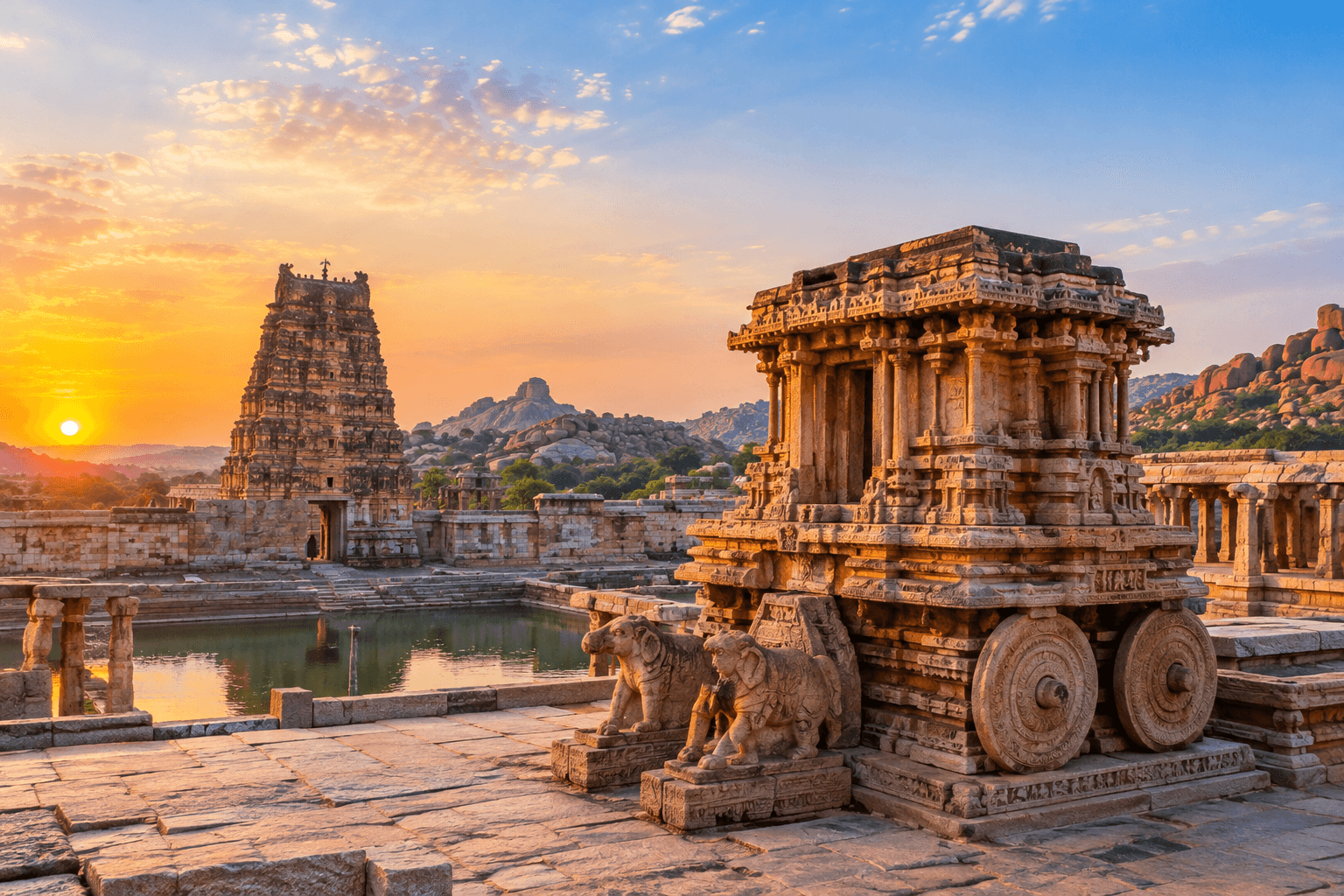
Table of Contents
Hampi doesn't look like India. That's the first thing most people think when the landscape appears, the enormous granite boulders balanced on each other across the hills, the Tungabhadra running through it, the ruins of what was once the wealthiest city in the world stretching across 26 square kilometres of terrain that looks like it was specifically designed to be dramatic. The Vijayanagara Empire's capital at its peak in the 15th century had a population larger than Rome. What remains is not a few preserved monuments. It's an entire ruined city, temples, market streets, royal enclosures, elephant stables, aqueducts, spread across a landscape that makes the scale of what existed here slowly land over hours rather than all at once.
The Virupaksha Temple first. It's the living temple at the heart of Hampi, not a monument but an active place of worship that has been in continuous use for over a thousand years. The gopuram at the entrance is the image most Hampi photographs are taken from. Go early, before 9am, when the morning rituals are happening and the tourist traffic hasn't built.
The Vittala Temple complex is the architectural centrepiece of the ruins and the things to do in Hampi list that doesn't put this at the top is missing the point. The stone chariot in the courtyard, the symbol that appears on the Karnataka state emblem, is the specific image. But the musical pillars in the main hall, which produce different tones when tapped, are the detail that makes the visit specific rather than photographic. The market street leading to the temple, the 1-kilometre colonnaded bazaar that the traders used during the Vijayanagara period, is best walked in the early morning when the light comes through the granite columns at the angle that makes the ruins look inhabited rather than empty.
The Royal Enclosure for the scale of the administrative complex, the Mahanavami Dibba platform from which the king watched the Dasara celebrations, the stepped tank, the elephant stables that held the royal elephants in a building that looks more like a piece of Islamic architecture than a Hindu empire's utility structure. The combination of architectural influences in Hampi is the specific thing the history books mention and the site makes immediately visible.
The Hampi Bazaar area, the village that has grown around the Virupaksha Temple, is the specific Hampi experience that the monument circuit doesn't cover. The small restaurants serving the traveller food that the backpacker trail has been sustaining for decades, the banana pancakes, the fresh juice, the specific café culture of a village that has been feeding travelling pilgrims and wandering visitors for generations.
Anegundi across the Tungabhadra, the older settlement that predates the Vijayanagara Empire, the birthplace of Hanuman according to the Ramayana, the Kishkinda of the epic visible in the landscape of the boulders and the river. The coracle crossing to get there is the journey as much as the destination.
The boulder climbing. Hampi's granite landscape is one of the most significant bouldering destinations in Asia and the international climbing community has been coming here specifically for decades. You don't need to be a climber to scramble up the smaller rock formations, the elevated position gives you the whole Hampi landscape in a way the ground level doesn't.
The river is the specific thing that makes Hampi's landscape what it is. The granite boulders, the ruins, the agricultural pockets between the rock formations, all of it makes sense from the river. The sunrise from the Hemakuta Hill above the Virupaksha Temple, looking over the river and the ruins in the first light, is the Hampi morning that justifies waking before dawn.
For things to do in Hampi that start from a base matching the destination, Kyriad Sarvesh Hampi is the property worth genuinely getting excited about. The Gangavathi-Hampi location gives you the ruins accessible without being inside the crowded village, clean and comfortable rooms, a restaurant covering the Hampi day from the pre-dawn breakfast before the Matanga Hill climb to the post-ruin dinner. Wi-Fi, AC, 24-hour front desk, the kind of property that handles things properly so the ruins can be the focus. The Hampi base that makes the whole visit work.
1. How many days do you need in Hampi?
Two full days covers the main monument clusters, the Vittala Temple, the Royal Enclosure, Virupaksha Temple, Hemakuta Hill, and a half day in Anegundi across the river. Three days adds the active experiences, the Matanga Hill sunrise, the cycling circuit, the boulder climbing. The serious heritage visitor with photography interests needs four.
2. What is the best time to visit Hampi?
October through February is the main window, the Karnataka winter, manageable temperatures, the light on the granite particularly good in the morning and late afternoon. November through January is peak season. March gets warm quickly. April and May are hot. The monsoon from June through September is dramatic but the roads to some monument clusters can be affected.
3. Is Hampi suitable for families with children?
Yes. The scale of the ruins is genuinely impressive for children of school age, the elephant stables, the stone chariot, the musical pillars at the Vittala Temple all produce the reaction that good heritage sites produce in curious children. The coracle crossing and the boulder scrambling add the active dimension.
4. How do you get to Hampi?
The nearest major railway station is Hospet Junction, approximately 13 kilometres from Hampi. Hubli airport is the nearest with regular connections, approximately 150 kilometres away. From Bengaluru, the overnight train to Hospet is the standard approach. From Goa, the Hubli route works well.
5. Is Hampi safe for solo travellers?
Yes. Hampi is well-established on the India travel circuit and solo travellers, particularly solo women, have been visiting for decades. The village around the Virupaksha Temple has a developed traveller infrastructure. Standard awareness applies as with any heritage tourism destination.